


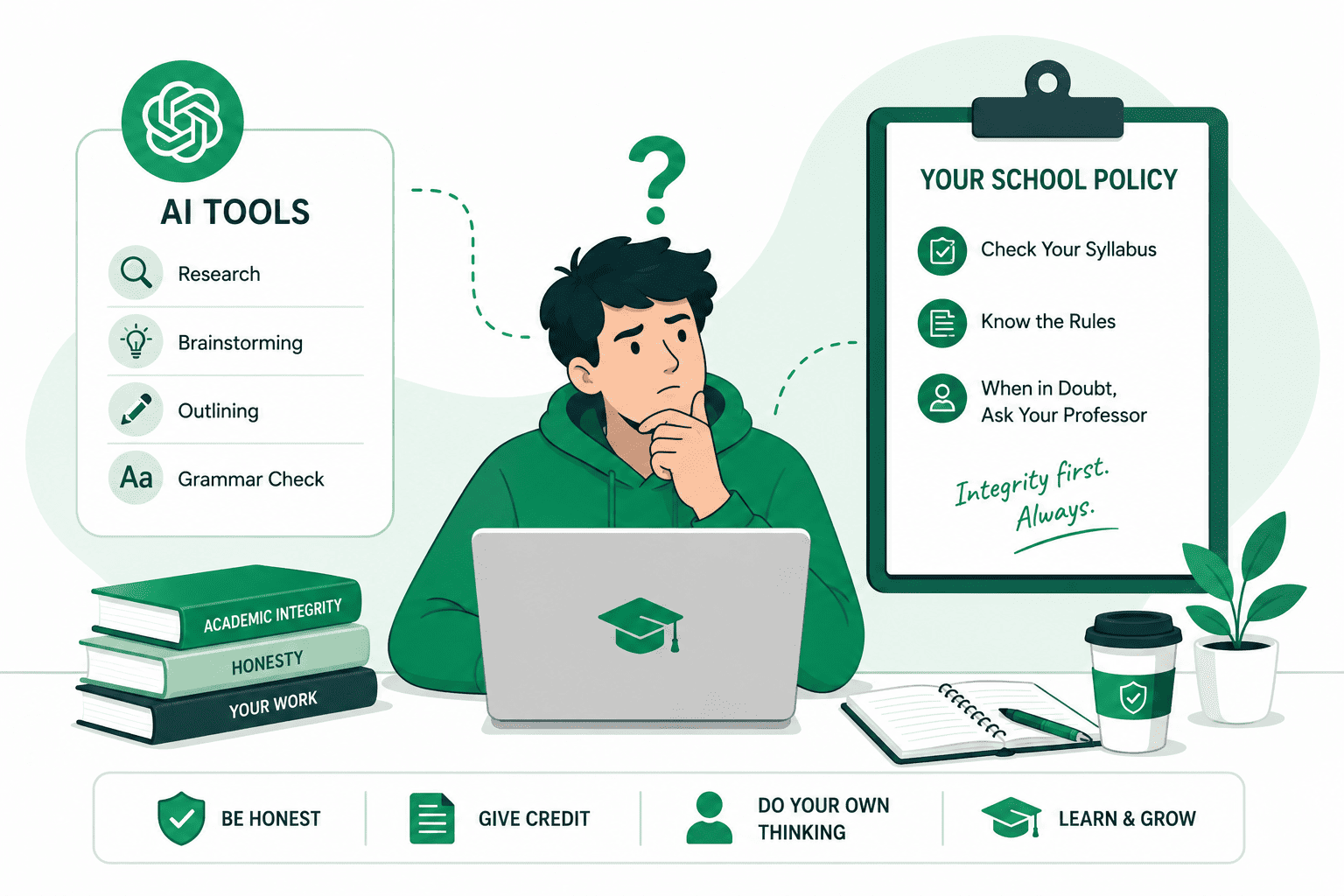
You've read the syllabus three times now, and you still don't know if what you did counts as cheating. You used ChatGPT to help outline your essay, then wrote most of the actual paragraphs yourself, then ran a grammar pass through an AI tool at 1am because your sentences felt clunky. Somewhere in there, you stopped being sure where the line was. Your professor never actually defined it, not clearly, and now you're staring at the submit button wondering if a detector is going to flag something you didn't even do wrong.
This is an incredibly common place to be in right now, and almost nobody talks about how genuinely confusing it is. Universities rolled out AI policies fast, often written by committees reacting to a panic rather than building something coherent, and the result is a patchwork of rules that contradict each other from one class to the next, sometimes from one professor to the next inside the same department. Before you submit anything you're even slightly unsure about, it helps to understand what these policies actually say, what the detectors your school uses can and can't tell, and where the real risk sits.
Why This Question Doesn't Have One Answer
Ask ten professors where they stand on AI-assisted work and you'll get eleven answers. One bans it outright, full stop, zero tolerance, treats any AI involvement as identical to plagiarism. Another requires disclosure, a line at the bottom of your paper noting you used ChatGPT to outline your argument, and considers that enough. A third barely mentions it, because their syllabus template is three years old and nobody's updated the honor code language since before ChatGPT existed in its current form. And a fourth actively encourages AI as a drafting tool, as long as the final analysis and argument are yours.
None of these professors are wrong, exactly. Academic integrity policy is set at the institutional level, but enforcement and interpretation happen at the level of an individual instructor grading an individual assignment, and that gap is where most of the confusion, and most of the actual risk, lives. The policy that matters isn't your university's general AI statement. It's whatever your specific professor wrote in the specific syllabus for the specific class you're submitting this specific essay to.
Reading Your Syllabus Like It's a Contract, Because It Kind of Is
Most students skim the AI policy section of a syllabus the same way they skim a terms of service agreement: fast, at the start of the semester, then never again. That's a mistake, because the language in these policies usually breaks down into a few recognizable categories, and knowing which one you're dealing with changes what's actually safe.
Fully prohibited. Language like "no generative AI tools may be used at any stage of this assignment" means exactly that. Not for outlining. Not for grammar checking. Not for "just bouncing ideas around." If your policy says this, treat it as absolute, because professors who write this language tend to enforce it strictly, and "I only used it a little" isn't a defense that tends to work.
Disclosure required. This is the most common category right now, and also the most misunderstood. Policies here usually ask you to state what you used AI for, sometimes in a footnote, sometimes in a separate statement submitted alongside the essay. The mistake students make constantly is assuming that if the final essay "sounds human enough" or passes a detector, disclosure doesn't matter. It does. Disclosure requirements aren't about whether you got caught. They're about whether you told the truth, and skipping it when it's required is itself the violation, regardless of how the writing reads.
Tool-permitted, output-restricted. Some policies allow AI for research, outlining, or grammar checking, but prohibit using it to generate substantive analysis or argument. This is the trickiest category to navigate honestly, because the line between "AI helped me organize my thoughts" and "AI wrote my thoughts" isn't always obvious, even to the student who did it.
Silent or ambiguous. If your syllabus says nothing at all, don't assume that means anything goes. Email your professor and ask directly. It takes two minutes, and "I wasn't sure, so I checked" is a genuinely good position to be in if a question ever comes up later.
What Detectors in Your School's Toolkit Actually Measure
Here's something that gets lost in a lot of the panic around this: the AI detection tools your university uses, whether that's Turnitin's AI writing indicator, GPTZero, Originality.ai, or something built in-house, don't read your essay for meaning. They can't tell if your argument is good, your citations are real, or your thesis makes sense. What they measure is statistical: how predictable your word choices are, called perplexity, and how uniform your sentence structure is, called burstiness. Low perplexity and low burstiness look like AI. High perplexity and high burstiness look human. That's genuinely most of what's happening under the hood.
It's worth knowing that Turnitin's AI indicator is layered on top of its older, more familiar similarity report, and the two get confused constantly. The similarity report checks your paper against a database of existing documents, other students' submitted work, published sources, the open web, looking for text that already exists somewhere. The AI indicator does something completely different: it analyzes your writing's statistical fingerprint in isolation, with nothing to compare it against except the general patterns of AI-generated text it was trained on. A paper can come back with zero similarity matches and still get a high AI score, and those two numbers are answering two entirely separate questions.
This matters for two reasons. First, it means these tools can be wrong in both directions, and the direction that should worry you most is the false positive: a paper you wrote entirely yourself getting flagged because it happens to be clean, well organized, and grammatically consistent, which ironically is exactly what a strong student writer produces and exactly what a detector is trained to associate with AI output. Non-native English speakers get flagged at meaningfully higher rates for this exact reason, since ESL writing instruction often teaches simpler, more predictable sentence structures, which look statistically similar to AI-generated text even though there's a human being who worked hard on every word. Students who write in a second or third language, who've spent years being taught to keep sentences clear and avoid idiom, are disproportionately caught in this net, and it has nothing to do with honesty.
Second, it means a "0% AI detected" score isn't a certificate of innocence, and a flagged score isn't a conviction. Different detectors disagree with each other constantly, sometimes wildly, because they're trained on different data and tuned to different thresholds. Run the same paragraph through two different tools and it's entirely possible to see a 12% score on one and a 68% score on the other. If your school treats a single tool's score as the final word without a human actually reading your work and comparing it to your writing history, that's a policy problem worth raising, not something you should just accept as settled fact.
The Line Between Assistance and Substitution
Most academic integrity violations involving AI aren't dramatic. Almost nobody sits down, has ChatGPT write an entire essay word for word, and submits it unedited hoping nobody notices. The more common version is quieter and blurrier: using AI to generate a rough draft, then editing it, then wondering, honestly, how much of it is still "AI writing" versus "your writing now that you've touched every sentence."
A genuinely useful way to think about it: assistance changes how you got somewhere. Substitution changes whether you actually understand where you ended up. If you used AI to help you outline an argument you already had in your head, that's assistance. If AI generated the argument and you're not entirely sure you could explain or defend it yourself under questioning, that's substitution, even if you've since rewritten every sentence in your own words. The test isn't how the final draft reads. It's whether you could sit in your professor's office right now and walk through your own reasoning, paragraph by paragraph, without the essay in front of you.
Say your assignment is a comparative essay on two historical treaties. Asking AI to summarize the basic terms of each treaty so you can spend your time on the comparison itself is assistance, the kind almost every permitted-tool policy allows. Asking AI to write the actual comparison, the argument about why one treaty succeeded where the other failed, and then rewording its sentences until they sound like you, is substitution wearing a disguise. The paragraphs might read identically to a detector. They are not remotely identical in terms of what you actually did.
This is also, not coincidentally, a good test for whether you're actually learning anything, which is the entire point of the assignment in the first place.
If You Get Flagged, Here's What Actually Helps
Being accused of an AI integrity violation is stressful in a specific way, because there's often no smoking gun, just a percentage on a report that feels impossible to argue with. A few things genuinely help if this happens to you.
Keep your drafts. Google Docs and Word both maintain version history automatically, and that history is one of the strongest pieces of evidence you can present, because it shows the actual, human, messy process of writing something: false starts, deleted paragraphs, edits made at 2am, sentences rewritten four different ways before you landed on one. AI-generated text doesn't have that history, because it didn't go through a process. If you've never checked whether your version history is turned on, do it today, for every assignment, starting now, regardless of whether you're worried about this specific paper.
Ask what the appeals process actually is, before you need it. Most universities have one, and most students have no idea it exists until they're already panicking. Knowing the process in advance means you can respond calmly and specifically instead of scrambling.
Don't argue with the percentage. Arguing "but it only said 62%, that's not that high" rarely works, and it also isn't really the point. The stronger argument is always about process: here's my outline from three weeks ago, here's my research notes, here's the version history showing four hours of edits on a Tuesday night, here's a professor from a previous class who can confirm this is how I normally write.
A Practical Framework Before You Submit Anything
Before you hit submit on something you've used AI assistance for, in any capacity, run through this:
- Read the actual syllabus language for this specific class, not your general assumption based on last semester or a different professor.
- When genuinely unsure, ask and get it in writing. An email reply from your professor is worth more than any guess you could make.
- Disclose when the policy asks for it, even if you're confident the writing "sounds human enough" to pass unnoticed. Disclosure isn't about detection. It's about honesty.
- Keep your version history on for every assignment, as a habit, not just the ones you're worried about.
- Ask yourself if you could defend every paragraph out loud, without the paper in front of you, if your professor asked you to right now.
- Don't assume a passing detector score means you're in the clear if you skipped a disclosure requirement. The two are unrelated questions.
Common Mistakes Students Make
The biggest one is treating "did it pass the detector" and "did I follow the policy" as the same question. They're not. You can write an essay that scores as fully human on every detector on earth and still be in violation of your specific class's policy if it required disclosure you skipped, or if the substantive argument came from AI rather than you regardless of how it reads.
The second is assuming policies are consistent across a university, when they're almost always set at the level of the individual instructor. What was fine in your intro class last year may not be fine in your seminar this semester, even if both professors technically report to the same department.
The third, and this one is genuinely avoidable, is running an AI-assisted draft through a humanizing tool and treating that as the finish line. A humanizer can help a legitimately human-edited draft sound less flat and more like your actual voice, and there's nothing dishonest about using one to fix rhythm and phrasing on writing you meaningfully engaged with. What it can't do, and shouldn't be asked to do, is manufacture the understanding you're supposed to be demonstrating. If you couldn't explain your own essay's argument to your professor's face, no amount of rewriting the sentences fixes that underlying problem.
The fourth is assuming a group project spreads the risk around. If one member of a group assignment uses AI in a way that violates the policy and the submission goes in under everyone's names, the fact that you personally didn't touch that section rarely protects you. Talk to your group about the class's specific policy before anyone starts drafting, not after someone's already used a tool the syllabus doesn't allow.
A Quick Scenario, Because Abstract Rules Are Hard to Apply
Say you're writing a literature review for a senior seminar. You used AI to help you find and summarize five papers faster than you could have manually, then wrote the actual synthesis, the part connecting those five papers into an original argument about a gap in the research, entirely yourself, over about six hours across four separate writing sessions. Your syllabus requires disclosure for any AI use in the research phase, so you add a short note explaining exactly what you used it for and why.
That's very likely fine under almost any reasonable policy, disclosed, honest, and the actual intellectual work, the synthesis, the argument, the thing your professor is grading, came from you. Now imagine the same scenario, except you skip the disclosure because the essay reads cleanly and you assume nobody will ask. Nothing about the writing itself changed. What changed is that you made a decision that isn't yours to make: whether disclosure matters. That decision belongs to your professor's policy, not to how confident you feel about not getting caught.
Frequently Asked Questions
If my essay passes every AI detector, am I safe from an academic integrity violation? Not necessarily. Passing a detector only means the text doesn't statistically resemble common AI patterns. It says nothing about whether you followed your specific class's disclosure requirements or whether the underlying argument and analysis are actually yours. Those are separate questions, and only one of them is what detectors measure.
Can a detector be wrong about my own original writing? Yes, regularly. Clean, well-structured, grammatically consistent writing can score as AI-generated simply because it shares surface statistical traits with machine output, particularly for students who write in a more formal or simplified style, including many non-native English speakers. A flagged score should prompt a human conversation, not an automatic penalty.
Is it safe to use AI for outlining even if the policy doesn't mention it specifically? If your syllabus is silent, ask your professor directly before assuming. A two-minute email is a much better use of your time than guessing wrong on an assignment worth a real percentage of your grade.
Does using a humanizer tool on my essay count as an integrity violation? It depends entirely on what the tool is being used for. Using one to improve the rhythm and phrasing of writing you genuinely wrote and understand is closer to using a grammar checker than to cheating. Using one to disguise the fact that AI generated your actual argument is a different situation, and the disclosure and substitution questions above still apply regardless of how polished the final draft sounds.
What should I do if I already submitted something and now realize it may have violated the policy? Talk to your professor before they come to you. Academic integrity offices consistently treat proactive disclosure more favorably than a violation discovered later, and most professors would rather have that conversation early than find out from a detection report.
Does it matter which AI tool I used, or just that I used one? Most policies are written in tool-agnostic language, "generative AI," rather than naming ChatGPT specifically, so switching to a different chatbot or a writing assistant doesn't change your obligations. What matters is what the tool was used for and whether that use falls inside what your specific class allows.
None of this is about finding a clever way around your school's rules. It's about understanding what those rules are actually asking of you, and making sure the thing you submit is something you could stand behind if your professor asked you to explain it, line by line, with nothing but your own memory of writing it.
 GPTZero
 Turnitin
 Originality.ai
 Copyleaks