


Your content calendar says forty articles this month, up from twelve a year ago, and the only reason that's even possible is that half your writers are now drafting with AI first and editing second. The problem is that readers can tell. Bounce rates are creeping up on exactly the pieces that got turned around fastest, your best client just asked, gently, why their blog "doesn't really sound like anyone," and somewhere in the building someone is nervously Googling whether Google actually penalizes AI content, because if the answer is yes, this whole scaled-up operation has a problem nobody's said out loud yet.
Here's the more useful way to think about it. The risk was never really "AI content specifically." It's flat, generic, forgettable content, and AI drafting at scale makes it dramatically easier to produce a lot of that very quickly. Building a workflow that avoids it isn't about avoiding AI. It's about putting the right checkpoints around it, in the right order, so specificity gets built in early instead of chased down later as damage control.
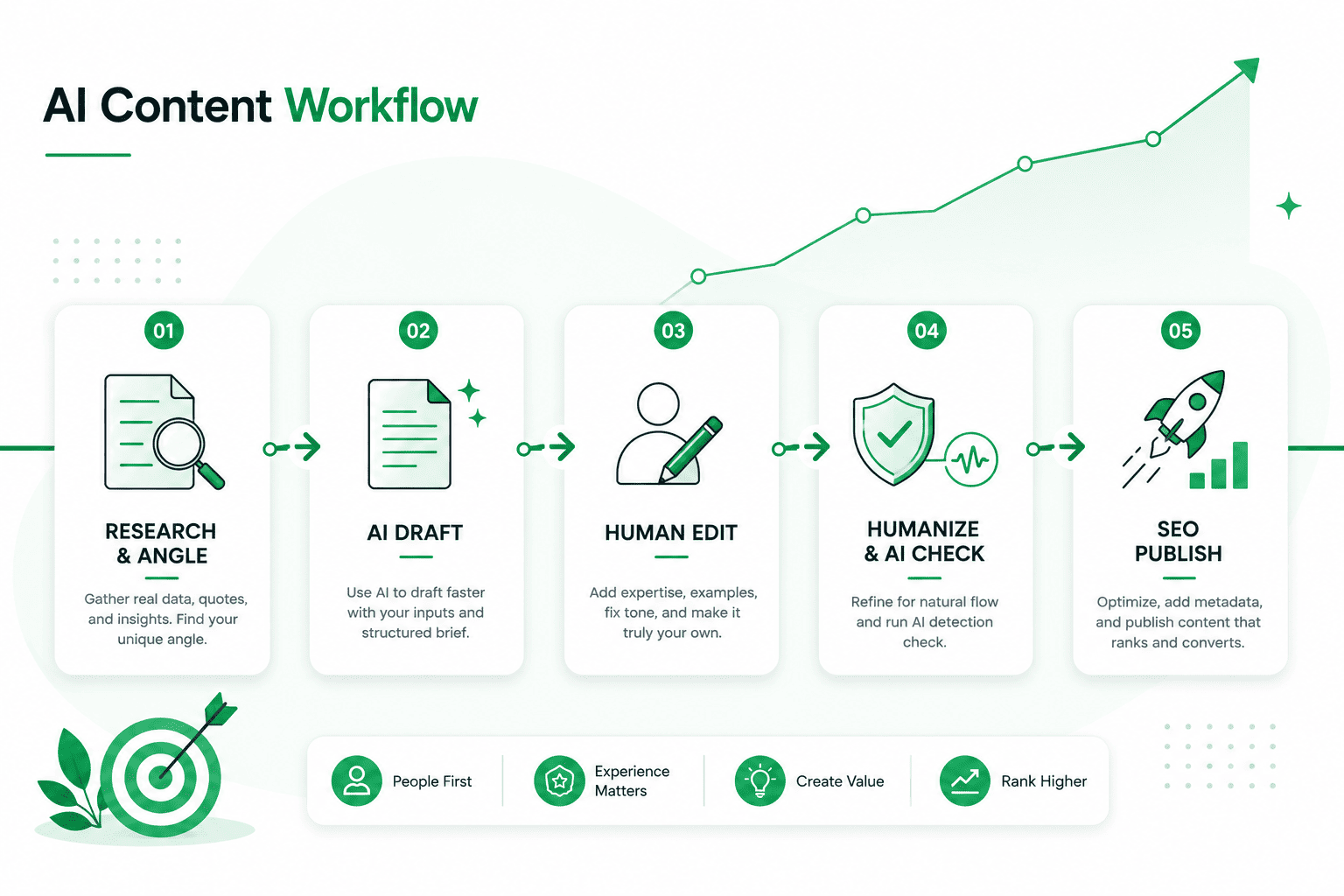
That order matters more than most teams expect. Skip a checkpoint at the start and no amount of polishing at the end fully makes up for it, the same way no amount of frosting fixes a cake that was never actually baked. The five stages below aren't extra work bolted onto a fast process. They're the fast process, just organized so each stage catches what the one before it can't.
Does Google Actually Penalize AI Content?
Google has said directly, more than once, that content isn't penalized simply because AI was involved in producing it. What gets penalized, consistently, is unhelpful content: thin, generic, unoriginal material produced primarily to rank rather than to genuinely help the person reading it. That's the same standard that's existed for years, applied to human-written SEO filler long before AI drafting tools existed.
What actually changes the risk calculation is Google's broader emphasis on experience and expertise signals, the practical upshot of what's often shorthanded as E-E-A-T. Content that reads like it came from someone who's actually done the thing, handled the edge case, made the mistake, tends to satisfy those signals whether a human typed the first draft or an AI did. Content that reads like an average of everything already published on the topic doesn't, regardless of production method. That's the real dividing line, and it's a content quality question dressed up as an AI question.
The uncomfortable truth for a lot of content operations is that "publish forty AI-assisted articles a month" and "publish forty genuinely helpful articles a month" are not automatically the same thing, and the gap between them is exactly where rankings, and reader trust, quietly erode. The fix isn't avoiding AI. It's building a process where AI handles the parts it's actually good at, and specific stages of human judgment handle the parts it isn't.
Stage 1: Research and Angle, Before AI Touches Anything
The single biggest mistake at scale is starting the process with a prompt. "Write a blog post about remote work productivity" produces exactly the kind of generic, average-of-everything content that both readers and detectors respond to as flat, because there's no specific human input anywhere in the chain yet.
Do the research first, the old-fashioned way. Pull a real statistic from a real source. Interview someone on your team about an actual mistake they made. Find the specific, weirdly particular detail that only exists because someone lived through it, someone tried something and it didn't work, someone has an opinion that isn't the safe consensus answer. This stage produces the raw material that makes everything downstream better, because you can't add specificity in an editing pass if nobody gathered any in the first place.
For that remote work productivity piece, this might mean pulling actual quotes from three people on your team about what genuinely changed their routine, including the systems that failed after a week. It might mean citing a specific survey with a specific number instead of "studies show." None of this takes long. It usually takes one Slack message and fifteen minutes, and it's the fifteen minutes that separates content that sounds like it came from somewhere real from content that sounds like it came from everywhere and nowhere at once.
Stage 2: Drafting With AI, Without Handing Over Control
Once you have real material, feeding it into an AI drafting tool works completely differently than starting from a blank prompt. Give the model your specific quotes, your actual data points, your particular angle, and ask it to draft around that material rather than invent its own generic version of the topic. The draft that comes back will still have the statistical hallmarks of AI writing, uniform sentence length, safe vocabulary, predictable structure, but it'll be built around real substance instead of average substance, which makes the next stage dramatically easier.
A structured brief helps here more than a clever prompt does. Specify the actual reader you're writing for, the real objection or question they have, and the one non-obvious insight the piece needs to land. Something like: "The reader has tried three productivity apps and quit all of them. They don't need another list of apps. They need to understand why the failure keeps happening." That single sentence of direction produces a meaningfully different draft than "write about productivity for remote workers," even from the exact same model.
Vague instructions produce vague drafts regardless of how sophisticated the underlying model is. This is worth repeating because it's the single most common way teams blame the AI tool for a problem that actually started with the brief.
Stage 3: The Human Editing Pass, Which Is Not Optional
This is the stage that gets skipped first when a team is under deadline pressure, and it's the stage that matters most. A human editor needs to do a specific, limited set of things, not a full rewrite:
- Break up any run of three or more sentences that are roughly the same length.
- Add at least one detail per section that only a person with real experience of the topic would know.
- Insert genuine hedging somewhere: an admission that a tactic didn't work for everyone, or a caveat the AI draft smoothed over.
- Cut the standard AI vocabulary tells: delve, moreover, furthermore, landscape, unlock, revolutionize, "it's worth noting."
- Read the whole piece out loud, start to finish, and fix anything that sounds like a manual instead of a person talking.
This pass takes a fraction of the time a full rewrite would, because the structure and research are already solid. What it adds is the specific, human texture that both readers and AI detectors respond to as genuine, for the same underlying reason: it's actually less predictable, in the good sense.
A Quick Before-and-After
Here's the same idea, drawn from that remote work piece, before and after this workflow.
Raw AI draft from a blank prompt: "In today's remote work environment, maintaining productivity can be challenging. Many professionals struggle with distractions and poor time management. It is important to establish a clear schedule and set boundaries. By implementing these strategies, remote workers can improve their overall efficiency and work-life balance."
Notice how none of it is wrong, and none of it is useful either. Every sentence is roughly the same length. Nothing points at a real cause or a real fix.
After research, briefing, drafting, and the human pass: "Three people on our team tried time-blocking apps last quarter. All three quit within two weeks, and the reason wasn't the app. It was that time-blocking assumes your day is predictable, and remote work with kids, roommates, or a partner on a different schedule almost never is. What actually stuck was smaller: a fifteen-minute buffer before the first meeting, no exceptions, used to close yesterday's tabs instead of opening today's."
Same underlying topic. Completely different rhythm, specificity, and usefulness, and one of them is also, not coincidentally, far less likely to read as AI-generated to a detector or a person.
Stage 4: Humanizing and Detection Checks at Scale
For a handful of articles, the manual editing pass above is enough on its own. For forty articles a month across multiple writers with different levels of editing experience, consistency becomes the real challenge, and this is where a dedicated humanizer tool earns its place in the workflow, as the last step, not a replacement for the stages before it.
A good humanizer targets exactly the patterns detectors flag: sentence-length uniformity, low-perplexity phrasing, formulaic transitions, and rewrites around them while preserving your meaning. The better tools let you freeze specific terms before running a piece through, your target keywords, your product name, a client's brand language, so a phrase like "time-blocking apps" doesn't quietly get rewritten into "scheduling software" halfway through a rewrite pass and break the exact search term the piece was built to rank for. They also check the output against multiple detectors rather than just one, since relying on a single tool's score is its own kind of risk, and disagreement between tools is common enough that a single green checkmark shouldn't be the whole plan.
Run this stage after the human edit, not instead of it. A humanizer can smooth out rhythm and structure at scale far faster than a human editor can do it forty times a month, but it can't invent the specific client interview detail or the real internal data point that made stage one worth doing.
Stage 5: SEO Quality Assurance
Before publishing, confirm the humanizing pass didn't quietly erode the SEO work from earlier stages. Check that target keywords and phrases survived intact, that headings still reflect actual search intent, and that internal links to related pieces are in place. None of this is unique to AI-assisted content specifically, it's the same QA any well-run content operation should be doing regardless of how a draft was produced, but it's easy to skip when a piece has already been through four other stages and everyone's ready to hit publish.
This is also the stage where a lot of teams catch structural drift they didn't intend. A humanizing pass that breaks up rhythm can occasionally flatten a heading into a sentence fragment that no longer matches how anyone actually searches for the topic, or split a numbered list into prose that loses its scannability. Neither is a disaster, but both are worth a five-minute check rather than an assumption that the piece that went in structurally sound came out the same way.
A Workflow Checklist You Can Actually Run Per Article
- Gather one real, specific detail, a stat, a quote, an internal data point, before any AI drafting starts.
- Write a structured brief naming the specific reader and the one insight the piece needs to deliver.
- Draft with AI around that material, not from a blank, generic prompt.
- Run the five-point human edit above: rhythm, detail, hedging, banned phrases, read-aloud.
- Run it through a humanizer with your key terms frozen, checked against more than one detector.
- Confirm SEO integrity before publishing: keywords, headings, internal links.
Common Mistakes Agencies and Content Teams Make at Scale
The most common failure is treating stage 4 as the whole process. A humanizer applied to a generic, unresearched, unedited AI draft still produces generic content, just with better sentence rhythm. It'll likely still score better on a detector, since rhythm and phrasing genuinely do move that needle, but it won't rank any better or read any more convincingly to an actual reader, because the specificity that both readers and rankings ultimately depend on was never there to begin with.
The second is inconsistent voice across writers, which becomes obvious fast once a client is reading four articles a month from what's supposed to be one consistent brand voice. Build the five-point human edit into a shared style guide so every editor is checking for the same things, not relying on individual taste.
The third is trusting a single detector's score as the final QA step. Different tools disagree with each other regularly, and building your process around one tool's threshold means you're only solving for that one tool's particular blind spots.
The fourth, and this one is easy to miss, is letting the humanizing pass run before the SEO-critical terms are locked in. If a rewrite happens before someone's confirmed the exact keyword phrases and headings the piece needs, it's common to come out the other side with a beautifully natural article that's quietly lost the search intent it was built to serve. Lock the terms first, humanize second.
The fifth is assuming this workflow only makes sense for large teams with dedicated editors. A single freelancer producing four articles a week can run the same five stages in a fraction of the time a full agency team would, precisely because there's no handoff overhead between people. The stages matter more than the headcount running them.
Frequently Asked Questions
Does using AI to draft content hurt SEO rankings? Not inherently. Google has stated that helpfulness, not the production method, determines ranking treatment. Thin, generic content ranks poorly whether a human or an AI produced it. A solid research and editing process, not avoiding AI entirely, is what protects rankings.
How much human editing time does this workflow actually add per article? Less than most teams expect, because the heaviest lifting, gathering real research and a specific angle, happens before drafting rather than as a rescue operation afterward. The five-point edit pass on a well-briefed AI draft typically takes a fraction of the time a from-scratch rewrite would.
Can a humanizer tool replace the human editing stage entirely? No, and treating it that way is the most common failure mode at scale. A humanizer fixes rhythm, phrasing, and structural predictability. It can't invent the specific, lived detail that a genuine editor adds, which is the part readers and search engines both ultimately respond to.
What's the single highest-impact change a content team can make? Move real research and a specific angle to before the AI drafting stage instead of trying to bolt specificity onto a generic draft afterward. Nearly every other problem in this workflow traces back to skipping that step under deadline pressure.
How do we keep a consistent brand voice when multiple writers are all using AI drafting tools? Codify the five-point human edit as a shared checklist rather than leaving it to individual taste, and keep a running list of approved and banned phrases specific to your brand. Consistency comes from a shared process, not from hoping every writer happens to edit the same way.
Does this workflow only work for large teams? No. A single freelancer or a two-person team can run the same five stages just as effectively, often faster, since there's no handoff between researcher, writer, editor, and QA. The value comes from the stages themselves, not from having a large team to run them.
How do we know if the humanizer stage is actually necessary for our team? If your editors are already consistently varying sentence rhythm, adding specific detail, and reading everything aloud before publishing, a dedicated tool may just save time rather than fix a gap. For teams publishing at real volume across multiple writers, it tends to be the difference between a process that holds up consistently and one that depends entirely on whichever editor happened to be sharpest that day.
 GPTZero
 Turnitin
 Originality.ai
 Copyleaks