

You can usually tell within the first two sentences. Not because you're some kind of AI detection expert, but because something about the rhythm feels off, even before you can name what it is. Maybe it's the way every sentence lands at almost exactly the same length. Maybe it's a phrase like "in today's fast-paced digital landscape" that makes your eyes glaze over before you've even reached the point. Whatever it is, your brain flags it before your conscious mind catches up.
That instinct is real, and it's worth understanding, because it turns out the difference between ChatGPT writing and human writing isn't mysterious at all. It comes down to a handful of specific, measurable patterns. Once you know what they are, you'll spot them everywhere, in emails, in blog posts, in that one coworker's Slack messages that suddenly got suspiciously polished last month.
Why This Even Matters Right Now
Google has said publicly that AI-assisted content isn't automatically penalized, what matters is whether it's genuinely helpful. Readers, on the other hand, are less forgiving. Studies on reader trust consistently show that once someone suspects a piece was AI-generated, their trust in the entire publication drops, even if the information itself is accurate. Add in the rise of AI detectors flagging content in schools, agencies, and publishing houses, and you've got a real, practical reason to understand the tells on both sides, whether you're trying to write more naturally yourself or trying to fix a draft that came out of a chatbot.
Let's get into the actual differences.
Sentence Rhythm: The Biggest Tell of All
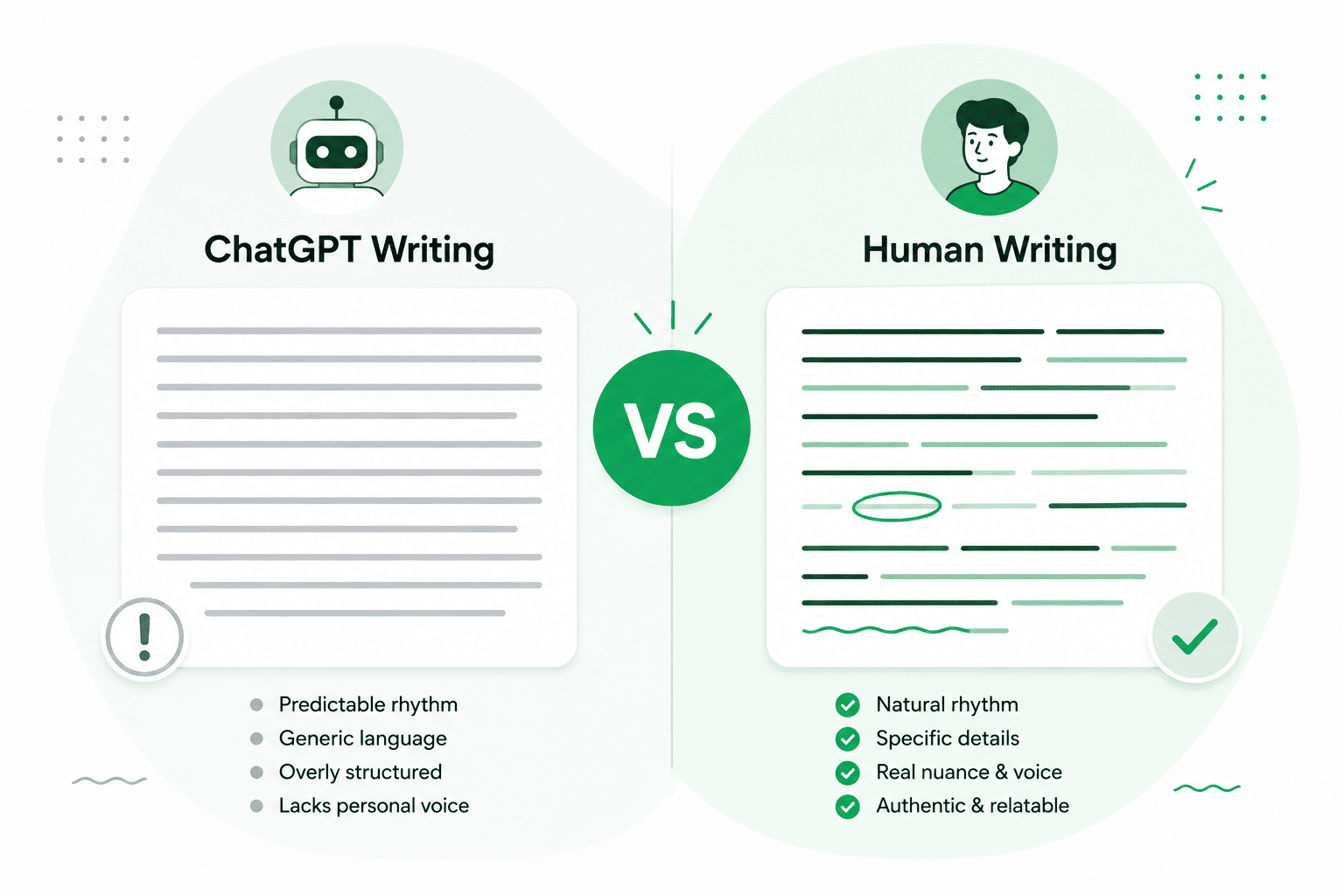
Read a ChatGPT paragraph closely and count the words per sentence. Nine times out of ten, they'll cluster tightly, usually somewhere between fifteen and twenty five words each. It's not a coincidence. Language models generate the statistically likely next word at every step, and that habit naturally smooths sentences into a similar length and shape, over and over, paragraph after paragraph.
Human writing doesn't do that. Ever. We write in bursts. A short one. Then something that runs long, picks up a clause partway through, doubles back on itself, and finally lands somewhere the reader didn't quite expect. That variation is called burstiness, and it's one of the clearest fingerprints separating machine text from a human hand, whether the human realizes they're doing it or not.
Here's a quick test. Take any paragraph and read only the sentence lengths, ignoring the words themselves. If they're all roughly the same size, you're likely looking at AI output, or a human writer who's unconsciously fallen into a monotone pattern, which happens more than people admit, especially under deadline pressure.
Predictability of Word Choice
This one has a name in linguistics: perplexity. It measures how surprising or predictable a word choice is given everything that came before it. Low perplexity means the model picked the safest, most statistically likely word every single time, which is exactly what it's built to do. High perplexity means the writer reached for something a little unexpected, a specific word, an odd but precise comparison, a phrase nobody else would have chosen in that exact spot.
ChatGPT defaults to low perplexity because that's the safest path through its training data. A human writer, especially one who's tired, annoyed, excited, or just being themselves, reaches for weirder, more specific language constantly. "The meeting dragged on forever" is low perplexity. "The meeting had that particular Tuesday-afternoon staleness where everyone's already checked out but nobody's brave enough to say it" is high perplexity, and it's also unmistakably something a person wrote, because it came from a specific, lived moment rather than an average of a billion similar sentences.
Specificity vs. Generic Abstraction
This is probably the easiest tell to spot once you're looking for it. AI-generated text tends to hover at the level of generality, because specifics require something the model doesn't have: an actual memory of a real event. Compare these two sentences.
Generic: "Many remote workers struggle to maintain a healthy work-life balance."
Specific: "I answered a Slack message at 9:40pm last Tuesday while eating dinner standing up at the counter, and that's when I realized my 'flexible schedule' had quietly become 'no schedule at all.'"
The second one isn't better because it's fancier. It's better because it's anchored in a real, checkable, particular moment. Nobody could have generated that sentence without actually living it, or at minimum, without being told exactly what detail to include. Generic AI writing floats above specifics because averaging across millions of documents naturally erases the particular in favor of the general.
Confidence Without Nuance
Ask ChatGPT a question and it will usually answer with the same even, steady confidence whether it's stating a well-established fact or making something up entirely. That flatness of tone across both certainty and uncertainty is a real tell, because human writers hedge constantly, and not as a weakness. Phrases like "I think," "in my experience," "this might not apply to everyone, but," and "I could be wrong here" are how real people signal that they're aware of the limits of what they know.
Oddly enough, research on trust and credibility shows that a small amount of hedging actually makes writing feel more trustworthy, not less, because total certainty reads as either naive or salesy. AI-generated text, left unguided, skips this entirely. It states everything with the same unwavering tone, which feels smooth right up until you notice there's no texture to it at all.
Structural Symmetry
Open up an AI-generated blog post and you'll often find suspiciously tidy structure. Three strategies, each explained in exactly the same format. A conclusion that neatly restates the introduction almost sentence for sentence. Transitions that always land in the same predictable spots: "moreover," "additionally," "in conclusion." It reads clean, almost too clean, like a form that got filled out correctly.
Human writing is lumpier. One section runs long because the writer got genuinely interested in a tangent. Another section is short because there wasn't much more to say. The ending sometimes trails into a new thought instead of circling back to a neat bow. That asymmetry isn't sloppiness. It's what actual thinking looks like when it gets put down on a page in real time.
The Vocabulary Tells
Certain words and phrases show up in AI-generated content so often that they've basically become a signature. If you see three or more of these in a single piece, that's a strong signal:
"In today's fast-paced [X] landscape"
"Delve into" or "dive into"
"It's worth noting that"
"Moreover" and "furthermore," especially stacked back to back
"Robust," "seamless," "unlock," and "revolutionize"
A conclusion that starts with "In conclusion" or "Ultimately"
None of these words are wrong individually. Plenty of human writers use "furthermore" now and then. The tell isn't any single word. It's the density and the predictability of where they show up, almost always in the exact same structural position, paragraph after paragraph.
What Human Writing Gets Wrong That AI Never Does
Here's an angle people rarely mention. Human writing has actual flaws, and those flaws are part of what makes it recognizable. A slightly awkward sentence that a good editor would tighten but a real writer left alone because it sounded right in their head. A tangent that doesn't perfectly serve the argument but adds personality. A joke that only half lands. An opinion stated a little too strongly, then walked back two paragraphs later.
AI-generated text, especially unedited, tends to be smoother than real human writing in a way that actually works against it. It's the writing equivalent of a face with no asymmetry at all, technically fine, but something about it doesn't sit right with people, and they usually can't say exactly why.
A Side by Side Example
Sometimes the difference is easiest to see laid out directly. Here's the same idea, productivity advice for freelancers, written two ways.
ChatGPT-style draft: "In today's competitive freelance landscape, it is important to maintain a structured schedule. Many freelancers struggle with time management, which can lead to missed deadlines and increased stress. Furthermore, setting clear boundaries with clients is essential for long-term success. By implementing these strategies, freelancers can improve their productivity and achieve a better work-life balance."
Notice the sentence lengths. Every single one lands in almost the same range. "Furthermore" shows up right where you'd expect it. Nothing is wrong, exactly, and nothing sticks either.
Human-edited version: "I missed a deadline last spring because I said yes to a client call at 6pm on a Friday, then spent the whole weekend resenting it instead of just saying no like a normal person would have. That's the actual lesson nobody tells you about freelancing. It's not about better time-blocking apps. It's about being willing to disappoint someone slightly now so you don't burn out completely later."
Same underlying advice. Completely different rhythm, specificity, and tone. One reads like a summary. The other reads like something that actually happened to a person.
Putting This Into Practice
If you're editing an AI draft to sound more human, or just trying to write more naturally yourself, here's where to actually focus your energy, in order of impact.
Fix sentence rhythm first. Go paragraph by paragraph and vary the length deliberately. This single change moves the needle more than any word-level edit.
Add one specific, personal detail per section. A real moment, a real number, a real mistake. This is the detail AI can't fake, because it requires lived experience.
Hedge somewhere. Admit uncertainty at least once. It's a small move that adds enormous credibility.
Cut the banned phrase list. Delve, moreover, furthermore, landscape, unlock, revolutionize. Just remove them and see how much cleaner the writing feels.
Let the structure breathe unevenly. Don't force every section into the same length or shape.
Read it out loud. This catches more robotic phrasing than any other single step, because your ear notices flatness your eyes skim right past.
For content at scale, doing all of this manually on every single piece isn't realistic, which is exactly the gap a dedicated humanizer tool is built to close. A good one targets these specific patterns, sentence-length uniformity, low perplexity phrasing, formulaic transitions, and rewrites around them while keeping your meaning and your target keywords intact, so you're not starting from zero on every article.
Frequently Asked Questions
Can you always tell ChatGPT writing apart from human writing just by reading it? Not always, and that's actually the point of this piece. The reliable tells are statistical patterns like sentence rhythm and word predictability, not something you can spot with total certainty on every read. Well-edited AI content can be genuinely hard to distinguish, while some human writing gets falsely flagged because it happens to be clean and well structured.
Is hedging language actually a sign of good writing, or does it just sound weak? Used well, it signals honesty rather than weakness. Total, unwavering confidence on every point tends to read as either naive or manipulative, while a reasonable amount of "in my experience" or "this might not apply to everyone" builds trust, because it shows the writer is aware of the limits of what they actually know.
Why does AI-generated content use the same words so often? Because those words and phrases are statistically the safest, most likely choices given the training data the model learned from. It's not a bug exactly, it's just what happens when a system is built to predict the most probable next word rather than to reach for something specific and unexpected.
What's the fastest way to make an AI draft sound more human? Fix the sentence rhythm first, then add one or two specific, personal details that only you could know. Those two changes alone address the two biggest tells: predictable rhythm and generic abstraction, and they take far less time than rewriting the whole piece from scratch.
 GPTZero
 Turnitin
 Originality.ai
 Copyleaks