


Someone in your group chat swears by a specific AI detector because it gave their essay a 100% human score, so now everyone uses that one exclusively, treating it like a stamp of legal approval. Meanwhile, someone else got a 91% AI score on a paragraph they wrote entirely themselves, in their own voice, about their own summer internship, and they're genuinely panicking because they don't understand how a machine could be that confidently wrong about something only they could have written.
Both of these situations come from the same root problem: a handful of myths about how AI detectors work that have spread so widely they're basically treated as fact now, in classrooms, newsrooms, and marketing meetings alike. Some of these myths make detectors sound more powerful than they are. Others make them sound more useless than they are. The truth, as usual, sits in a much messier middle, and it's worth actually walking through it, myth by myth, because a lot of real decisions, grades, job offers, published corrections, are getting made on the back of these misunderstandings right now, often by people who've never once looked at how the underlying technology actually works.
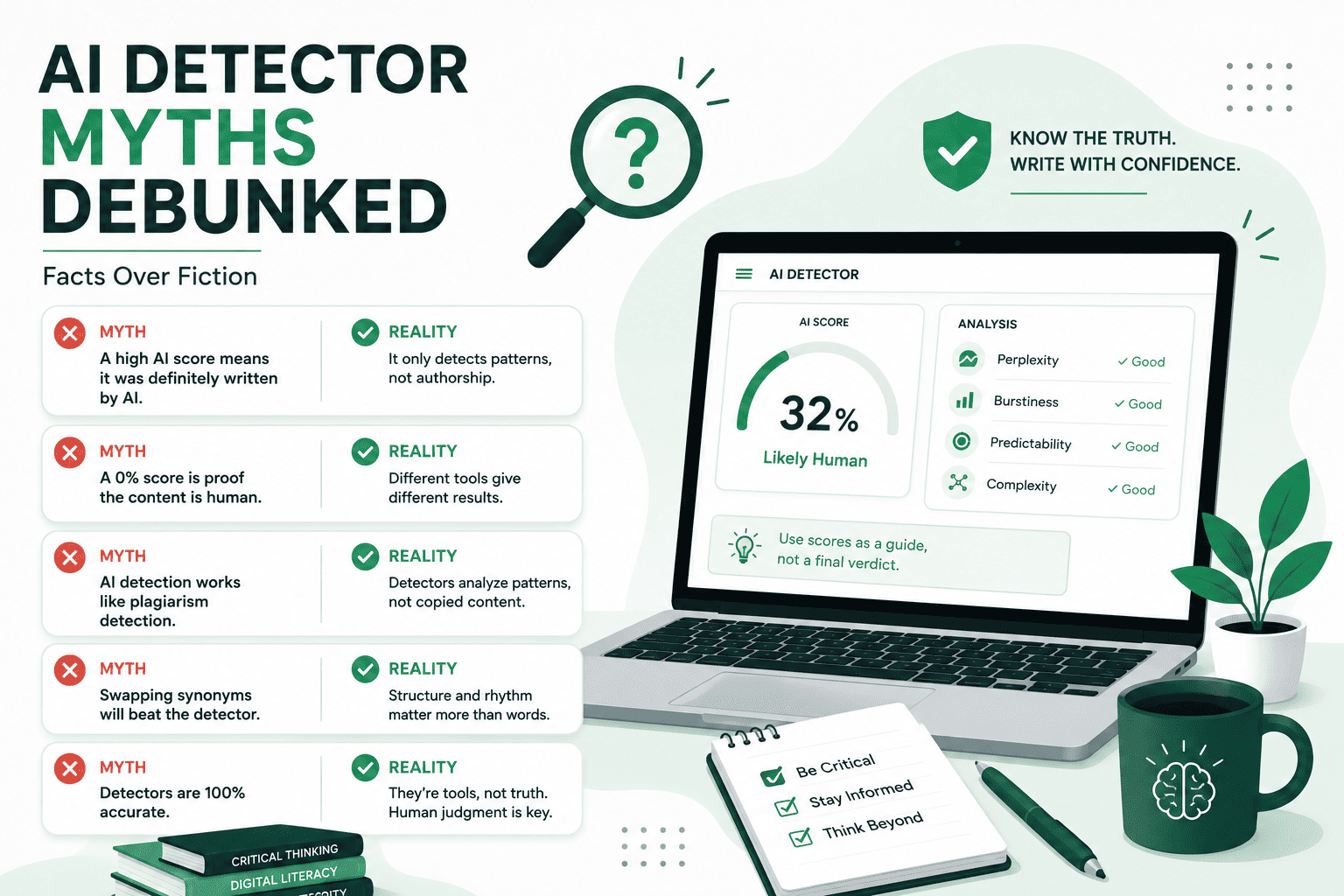
Myth 1: A High AI Score Means the Text Was Definitely Written by AI
This is the single most damaging myth in circulation, mostly because it sounds so reasonable. A detector says 87% AI-generated, so surely that means 87% of the text came from a machine, right? Not quite. Detectors don't verify authorship. They measure statistical patterns: how predictable your word choices are and how uniform your sentence lengths are. Text that happens to share those patterns gets flagged, regardless of who actually typed it.
This is exactly why clean, well-organized human writing gets falsely flagged constantly, especially from writers who were taught clear, simple sentence structure as a strength, which includes a lot of strong student writers, technical writers, and non-native English speakers. A high score is a statistical signal worth investigating, not a verdict. Think about the kind of writing that tends to get taught as "good" in a formal setting: topic sentence, three supporting points, consistent length, no fragments, no tangents. That's precisely the shape a detector is trained to associate with a machine, because it's also, structurally, the shape a machine defaults to when nobody tells it otherwise.
Myth 2: A 0% Score Is Proof the Content Is Human
The flip side of Myth 1 is just as widespread and just as wrong. A clean score on one detector means that particular tool, trained on its particular dataset with its particular thresholds, didn't find the patterns it's looking for. It doesn't mean a different detector would agree. Run the same paragraph through three separate detectors and it's common to see meaningfully different results, sometimes a 5% score on one and a 60% score on another, from the exact same text.
If you're relying on a single tool's clean bill of health as your entire safety net, whether you're a student, an editor, or a content manager, you're trusting a coin that's only been flipped once.
Myth 3: AI Detection Works the Same Way as Plagiarism Detection
These get confused constantly, and they're built on completely different mechanisms. A plagiarism checker like Turnitin's traditional similarity report compares your text against a massive database of existing documents, looking for matching strings of words. It's checking whether your text already exists somewhere else.
An AI detector isn't comparing your text to anything. It's analyzing the statistical fingerprint of the text itself, in isolation, looking for the low-perplexity, low-burstiness patterns typical of language model output. You can write something completely original, zero overlap with any existing document anywhere, and still get flagged by an AI detector, because originality and "statistically resembles AI output" are unrelated properties of a piece of writing. You could, in theory, plagiarize a paragraph word for word from a human-written 1990s magazine article and have it score as perfectly human, while an entirely original paragraph you wrote last night scores as 70% AI, because one system is checking for copied words and the other is checking for a completely different statistical signature.
Myth 4: Swapping in Synonyms Will Beat the Detector
This one persists because it feels intuitive. If the detector is looking at word choices, changing the words should help, right? Except detectors aren't really scoring individual word choices in isolation. They're scoring the predictability of the whole sequence and the uniformity of sentence structure across the piece. A thesaurus pass changes vocabulary tier without touching sentence rhythm or structural predictability at all, which means the underlying signal a detector is measuring stays almost completely unchanged. You've repainted the fence. The shape of the yard is identical.
There's a whole category of browser extensions and quick-fix tools built entirely around this myth, running a document through a synonym swap and calling the job done. Test one yourself sometime: run a flagged paragraph through a synonym tool, then run the result back through the same detector. The score barely moves, because the sentence lengths, the structure, and the rhythm underneath the fancier vocabulary are exactly what they were before.
Myth 5: Detectors Are Reliable Enough to Base Real Consequences On, By Themselves
Universities, employers, and publications have increasingly leaned on AI detection scores as if they were forensic evidence, and that reliance has caused real problems, including documented cases of students disputing false accusations based on a single tool's output with no additional human review. The honest state of this technology right now is that detectors are a useful first-pass signal, worth investigating further, not a standalone basis for a grade, a firing, or a retraction. Any policy that treats a single automated score as final, without a human actually reading the work and weighing context, is relying on the tool for more certainty than it actually offers.
Some of the more careful institutions have started walking this back publicly, adding language that a detection score alone can't be used as the sole basis for a disciplinary decision. That shift didn't happen because the tools got worse. It happened because enough false positives surfaced that the risk of punishing genuine students became impossible to ignore.
Myth 6: Short Content Is Automatically Safer From Detection
The logic here is that a shorter sample gives a detector less to work with, so it should be less likely to flag anything. In practice, detector confidence generally scales with sample length in both directions: short samples often produce less reliable results overall, which can mean a false negative just as easily as a false positive. A two-sentence product description can score wildly differently than the same writer's full-length article, and neither score should be treated as more trustworthy just because the piece is shorter. If anything, a very short sample gives a detector so little to work with that its confidence interval, which most public-facing tools don't even show you, is often wide enough to make the headline percentage close to meaningless.
Myth 7: Non-Native English Speakers Just Have to Accept Getting Flagged More Often
This one is technically true as an observation and genuinely unfair as a conclusion. Research and reporting on AI detection tools have repeatedly found that non-native English writers get flagged at disproportionately higher rates, largely because ESL writing instruction often emphasizes simpler vocabulary and more uniform sentence structure, the exact statistical pattern detectors associate with AI output. That's a real, documented limitation of the technology, not a personal failing of the writer, and it's a strong argument for why no institution should treat a detector score as sufficient evidence on its own, without a human reviewer who knows the writer's history and context.
Myth 8: Using an AI Humanizer Is the Same Thing as Cheating
This myth conflates two very different behaviors. Using a humanizer to disguise AI-generated work you're presenting as entirely your own, in a context where that's against the rules, is dishonest, and no tool changes that underlying fact. Using a humanizer to revise the rhythm and phrasing of writing you actually engaged with and understand, the same way you'd use a grammar checker or an editor, is a completely different situation. The tool itself isn't the ethical line. What you're using it for, and whether you're being honest about your process where honesty is required, is what actually matters.
Compare it to a calculator. Using one to check your arithmetic on a problem you solved yourself isn't cheating. Using one to produce an answer you couldn't derive and don't understand, then presenting that as your own reasoning, is a different situation entirely, and the calculator was never the part that made it dishonest. The same logic applies to spell-checkers, grammar assistants, and citation managers, none of which anyone seriously argues are cheating, even though all of them change the final text you submit.
Myth 9: Detectors Are Getting So Good That This Problem Will Solve Itself
It would be convenient if this were true. It isn't, at least not yet. Detection and generation are locked in a moving target: every time detectors get better at spotting a pattern, the models generating text shift slightly in ways that make the old pattern less reliable. Meanwhile, the false positive problem, flagging genuine human writing, hasn't been solved by better detection models, because it stems from the fact that clean, predictable writing looks statistically similar whether a person or a model produced it. Assuming this will quietly resolve itself is a bet against a moving target, not a safe long-term plan.
Myth 10: Detectors Work Just as Well in Every Language
Almost all of the widely used AI detectors were trained primarily, sometimes almost exclusively, on English text. Their accuracy on other languages varies a lot, and generally drops the further a language sits from the training data they were built on. A detector that's genuinely useful on English essays can be close to a coin flip on the same student's work in Portuguese or Vietnamese, and very few schools or platforms disclose that limitation anywhere near the score they show you. If you're evaluating non-English content, or content translated from another language, treat any detector score there as far less reliable than the same tool's English results, not equally trustworthy.
Myth 11: A Detector Score Is Solid Evidence in a Professional or Legal Dispute
This comes up more than you'd expect, in workplace disputes over a fired freelancer's "AI-generated" article, in journalism corrections, in contract disagreements over whether delivered work matches what was promised. A single automated score, from a tool with no peer-reviewed accuracy standard and a documented false positive problem, is a thin foundation for a real consequence. Employers and clients relying on this as their sole justification are standing on the same shaky ground as a university treating one Turnitin score as an automatic conviction. It's a reason to ask more questions, not a substitute for asking them.
Myth 12: A Detector Can Tell You Which AI Model Wrote Something
People sometimes assume a detector's report is more specific than it actually is, that a tool can distinguish ChatGPT's fingerprint from Gemini's or Claude's the way a handwriting expert might identify an author. In practice, almost all consumer-facing detectors report a single, general "AI-like" score without attributing it to any particular model. They're detecting a family of statistical patterns common across most modern language models, not fingerprinting a specific one. Any claim that a tool identified "which AI wrote this" with real confidence is overselling what the underlying method can actually do.
So What Should You Actually Trust?
Treat any single AI detector score as one data point, not a verdict. Check important content against more than one tool before drawing a conclusion either way, and weigh the result differently depending on the language, the writer's background, and the length of the sample. If you're an institution setting policy, build in human review for anything with real consequences attached, because the tools genuinely aren't reliable enough yet to stand alone. If you're an employer or a client evaluating someone's work, the same rule applies: a score is a prompt for a conversation, not grounds for a decision by itself.
And if you're a writer worried about a false flag, here's the genuinely reassuring part: the same practices that make writing better, specific detail, varied sentence rhythm, an honest voice that admits what it doesn't know, also happen to be the things that move a detector score in your favor. You're not choosing between writing well and passing a checker. Chasing one usually gets you the other for free.
It's also worth remembering that this technology is still genuinely young. The tools you're using today will very likely be tuned differently in a year, trained on more data, adjusted in response to exactly the false positive complaints that keep surfacing. That's a reason for cautious optimism, not a reason to treat today's version as more settled or more authoritative than it actually is. Build your habits, and your institution's policies, around the honest limitations of the current tools, and you'll be in a far better position than someone who bet everything on a single score being permanently correct.
Frequently Asked Questions
Which AI detector is the most accurate? None of them are accurate enough to be treated as a single source of truth. They disagree with each other regularly, and the honest approach is to treat any one score as a starting point for further review rather than a final answer.
Can AI detectors tell the difference between AI-assisted and fully AI-generated content? Generally no. Most detectors measure statistical patterns across the whole piece rather than tracing which specific sentences came from where, so heavily-edited AI-assisted work and unedited AI output can sometimes score similarly, or very differently, depending on how much the human editing pass changed the underlying rhythm.
Why do detectors disagree with each other so much? Each one is trained on different data, tuned to different thresholds, and built by a different team with different assumptions about what "AI-like" text looks like. There's no shared, universal standard they're all measuring against.
Is it possible to write something completely human that still gets flagged? Yes, and it happens often, particularly with clean, simple, well-structured writing, technical documentation, and non-native English speakers' work. A flagged score should prompt a closer look, not an automatic assumption of dishonesty.
Do AI detectors work as well on non-English content? Generally no. Most were built and trained primarily on English text, and accuracy on other languages tends to be noticeably lower and less studied. Treat scores on non-English or translated content with extra caution.
Should a school or employer ever act on a single detector score alone? No. Given the documented false positive rate and the disagreement between different tools, a single score should prompt further review by a person familiar with the writer's history and context, not stand in as the final decision on its own.
Can a detector tell me which specific AI tool was used to write something? No, not reliably. Most detectors report a general likelihood that text resembles AI-generated patterns as a category, without attributing that pattern to a specific model like ChatGPT, Gemini, or Claude. Treat any claim of model-specific attribution with skepticism.
 GPTZero
 Turnitin
 Originality.ai
 Copyleaks