


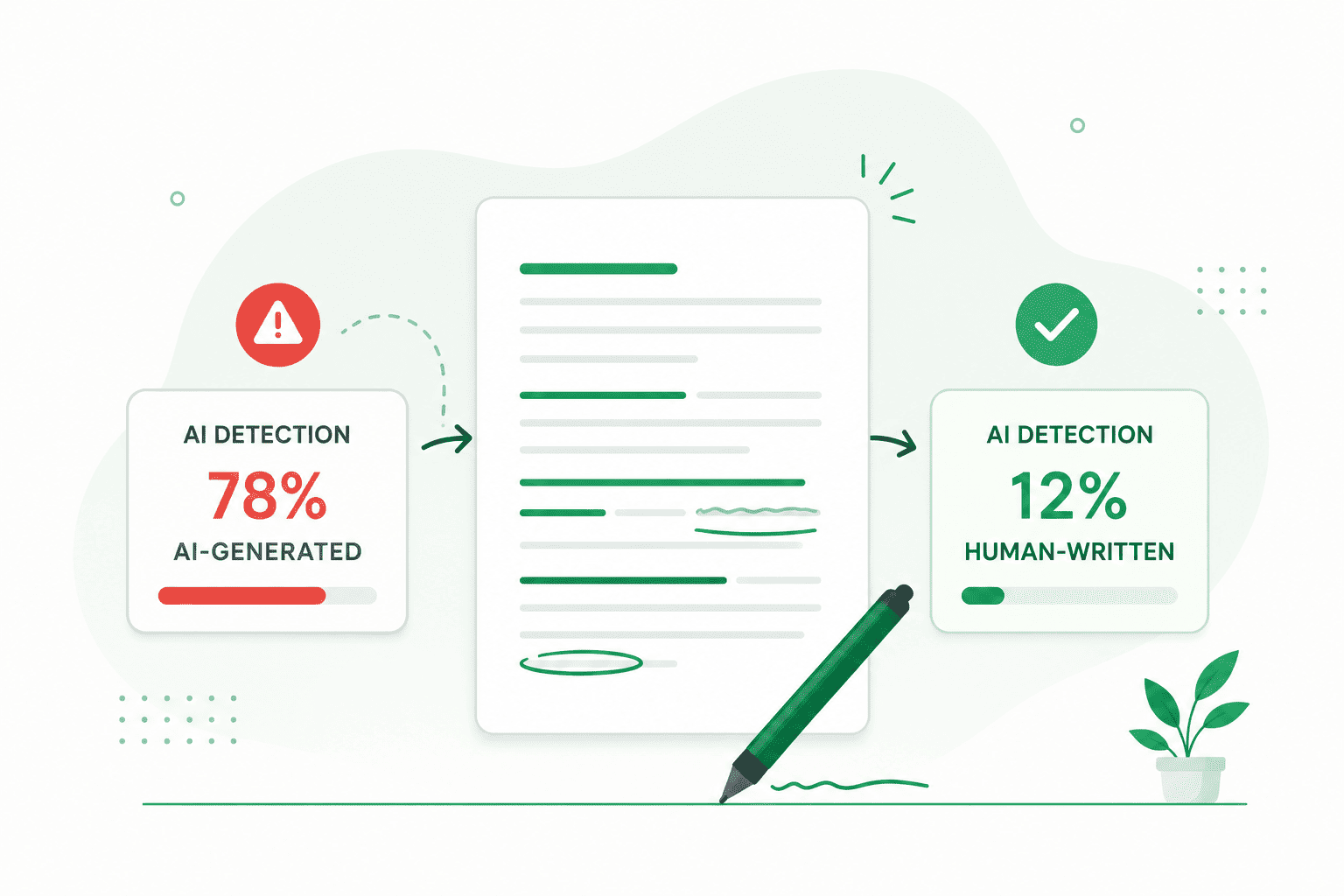
You already know the feeling. You wrote something yourself, every word of it, and an AI detector still slapped a 78% AI-generated score on it. Or maybe you did use ChatGPT for a first draft, cleaned it up for an hour, and it still reads as robotic to a checker that doesn't know the difference between "AI-assisted" and "AI-written." Either way, you're staring at a red flag you didn't earn, and now you need to fix it before a client, a professor, or an editor sees it.
This happens more than most people admit out loud. AI detectors were built fast, trained on limited data, and they're notoriously unreliable at telling the difference between genuinely careful writing and machine output. Plenty of published, human-written articles get flagged simply because they're well structured and grammatically clean, which ironically is exactly what a detector expects from AI. So before you panic, it helps to understand what these tools are actually measuring, because once you know that, fixing your content stops being guesswork.
What AI Detectors Are Actually Looking At
Here's the part almost nobody explains clearly. AI detectors don't read your writing for meaning. They don't know if your argument is good or your facts are accurate. They're measuring statistical patterns, mainly two of them.
Perplexity measures how predictable your word choices are. Low perplexity means every word follows naturally and safely from the one before it, which is exactly how language models write by default, since they're built to pick the statistically likely next word. High perplexity means your word choices are less predictable, which is a hallmark of human writing, since people reach for odd phrasing, specific vocabulary, and unexpected turns of phrase constantly.
Burstiness measures variation in sentence length and structure. Human writing naturally swings between short and long. A quick sentence. Then something longer that winds through a thought, adds a clause, circles back, and lands somewhere the reader didn't quite expect. AI text, left alone, tends to land in a narrow band of sentence lengths over and over, which creates a rhythm that a detector can measure even without understanding a single word of what you wrote.
Detectors also look for repeated structural patterns: identical paragraph shapes, formulaic transitions, symmetrical "on one hand, on the other hand" constructions, and a handful of words models reach for constantly, like "moreover," "delve," and "in today's landscape." None of these signals are about content quality. They're about pattern recognition, which means the fix isn't to write something more true. It's to write something less predictable.
Why "Just Edit It a Little" Doesn't Work
Most people's first move is to swap a few words, add a contraction or two, and call it done. I get why. It feels like the fastest fix at 11pm when a deadline is breathing down your neck. But surface edits rarely move the actual metrics a detector is measuring, because the underlying sentence structure and rhythm stay exactly the same. You've changed the paint, not the frame.
This is the same mistake behind a lot of failed "humanizing" attempts. Someone runs their AI draft through a thesaurus pass, replaces a dozen words with fancier synonyms, and submits it thinking the job is done. Detectors don't care about your vocabulary tier. They care about sentence-level unpredictability and rhythm, and word swaps alone almost never touch either one.
The Real Fixes That Actually Change Detection Scores
1. Break the Rhythm on Purpose
Go through your draft sentence by sentence and look at length. If three sentences in a row are all roughly the same size, that's your tell. Cut one down to five words. Let another run long, with a clause tacked on that explores the idea a bit further than feels strictly necessary. This isn't about making the writing worse. It's about making it move the way a real person's thinking moves, which is rarely in a straight line.
2. Add Detail Only You Would Know
This is the single most effective fix, and it's the one AI can't fake for you. Specific, personal detail is nearly impossible for a model to invent convincingly, because it requires lived experience. Instead of "many writers struggle with consistency," write "I missed three Tuesday posts in a row last month because I kept rewriting the same intro at midnight." The second version isn't just more human sounding. It's structurally different in a way detectors respond to, because it introduces vocabulary and sentence shapes a model wouldn't generate on its own.
3. Say What Didn't Work
AI-generated content tends to state everything with the same even confidence, whether it's a fact or an assumption. Real writing hedges. It admits uncertainty. It says "I thought this approach would be simple and it wasn't" or "this worked for about half my clients, and I'm still not sure why it didn't for the rest." That kind of vulnerability is a strong human signal, and it's genuinely difficult for a model to generate convincingly without being told to.
4. Kill the Banned Phrase List
Certain words and phrases are practically a signature of AI drafts: "delve into," "in today's fast-paced world," "moreover," "it's worth noting," "furthermore," "unlock," "revolutionize," "robust." Search your draft for these and cut every single one. It sounds small, but it's one of the fastest wins available, because these phrases show up constantly in raw AI output and rarely in natural human writing.
5. Read It Out Loud Before You Submit Anything
This single habit catches more robotic writing than any tool or checklist. If your voice flattens by the second paragraph, if you stumble over a phrase that looked fine on the page, that's the tell. Real speech has rhythm your ear picks up even when your eyes skim right past it. Fix anything that sounds like you're narrating a manual, and read it again.
6. Restructure, Don't Just Reword
If your paragraph structure is symmetrical, three strategies with identical formatting, a rule-of-three list, a tidy conclusion that just restates the intro, that symmetry is itself a signal. Break it up. Let one section run longer than the others. Drop a strategy in the middle of an anecdote instead of introducing it with a clean topic sentence. Uneven structure reads as more human because it usually is.
Where a Tool Like an AI Humanizer Actually Helps
Doing all six of the above by hand, for every piece of content you publish, is realistic for one article. It is not realistic for a content calendar. This is where a dedicated humanizer tool earns its place in the workflow, not as a replacement for the judgment above, but as a way to apply it at scale.
A good AI humanizer analyzes your draft specifically for the patterns detectors flag, sentence-length uniformity, low perplexity phrasing, formulaic transitions, and rewrites around them while keeping your meaning and your keywords intact. The best ones let you freeze specific terms so your SEO targeting doesn't get scrambled in the process, and they check the output against the same detectors your readers or reviewers are likely to use, so you're not guessing whether it worked.
What a humanizer can't do is invent the specific, lived detail that makes writing genuinely convincing. That part still has to come from you. Think of it as the difference between generation and refinement. AI can produce a structurally sound first draft quickly. A humanizer can restructure that draft so the rhythm and phrasing stop looking like a fingerprint. But the sentence about missing three Tuesday posts because you kept rewriting the same intro at midnight, that one's still yours to write.
A Word on Why This Matters Beyond Just Passing a Checker
It's worth being honest about the goal here. The point isn't to trick anyone into believing something false. It's that AI detectors are frequently wrong, they flag legitimate human writing at meaningful rates, and relying on AI assistance for a first draft, then genuinely reworking it into something specific and true, is a completely normal part of how writing gets done now. Search engines have said the same thing publicly: they don't penalize AI-assisted content, they penalize low-quality, unhelpful content, regardless of how it was produced.
So the actual goal, whether you're a student worried about a false positive, a marketer publishing content at scale, or a freelancer trying to protect your reputation with a client, is the same. You want writing that's genuinely worth reading, that sounds like a specific person wrote it, and that happens to pass detection because it earned that outcome rather than gamed it.
Common Mistakes That Get People Flagged Anyway
Relying on a thesaurus pass. Swapping "utilize" for "use" and "important" for "crucial" changes vocabulary, not structure. Detectors barely notice, because the sentence shape and rhythm underneath are identical to the original draft. If you find yourself opening a thesaurus tab as your main strategy, stop and work on sentence length instead.
Fixing the intro and ignoring the rest. People pour their energy into a strong opening paragraph, since that's what they reread most, and then leave the middle and the ending untouched. Detectors score the whole piece, not just the first hundred words, so a flat, uniform middle section will drag your score right back down even if the opening is genuinely strong.
Over-correcting into chaos. Some writers hear "vary your sentences" and swing too far, chopping everything into short, choppy fragments that read like a ransom note. Burstiness means genuine variation, some short, some long, in a pattern that still makes sense to read. It's not the absence of structure. It's structure that isn't perfectly even.
Trusting a single detector's score. Different detectors use different models and different thresholds, and they disagree with each other constantly. A piece that scores as 90% human on one tool can score 40% on another. Check your work against more than one detector before you treat any single score as the final word.
Forgetting the reader entirely. It's easy to get so focused on gaming a score that you lose sight of the actual person who's going to read the piece. Writing that's built around a specific reader's frustrations and questions naturally ends up more varied and more specific anyway, since you're responding to a real situation instead of generating generic advice. Chasing the reader and chasing a lower AI score usually turn out to be the same job.
A Quick Pre-Publish Checklist
Before you hit publish or submit anything you're even slightly worried about, run through this:
Does any paragraph have three or more sentences of nearly identical length? Break the rhythm.
Is there at least one specific, personal detail a model couldn't have invented?
Did you admit anywhere that something didn't work, or that you're uncertain?
Did you cut every phrase from the banned list: delve, moreover, furthermore, unlock, revolutionize, landscape?
Did you read the whole thing out loud, start to finish?
Does the structure feel uneven in places, rather than perfectly symmetrical?
If you can check most of these boxes, you're not just more likely to pass a detector. You've actually written something better, which was the point all along.
Frequently Asked Questions
Can AI detectors be wrong about human-written content? Yes, regularly. Detectors measure statistical patterns like predictability and sentence rhythm, not authorship. Clean, well-structured human writing can score as AI-generated simply because it happens to share those surface traits.
Does using an AI humanizer hurt my SEO? Not when it's done properly. Tools that let you freeze specific keywords and phrases preserve your targeting while rewriting the surrounding structure and rhythm, which actually tends to help readability, and readability is something search engines do reward.
Is it against the rules to use AI for a first draft? That depends entirely on the platform, publication, or institution you're submitting to. Many now explicitly allow AI-assisted drafting as long as the final content is reviewed, accurate, and genuinely useful. Always check the specific policy that applies to you.
What's the fastest single fix if I'm on a deadline? Read it out loud and fix anything that sounds flat, then add one or two specific details only you would know. Those two moves alone address both the rhythm problem and the specificity problem, which are the two biggest signals detectors pick up on.
 GPTZero
 Turnitin
 Originality.ai
 Copyleaks