

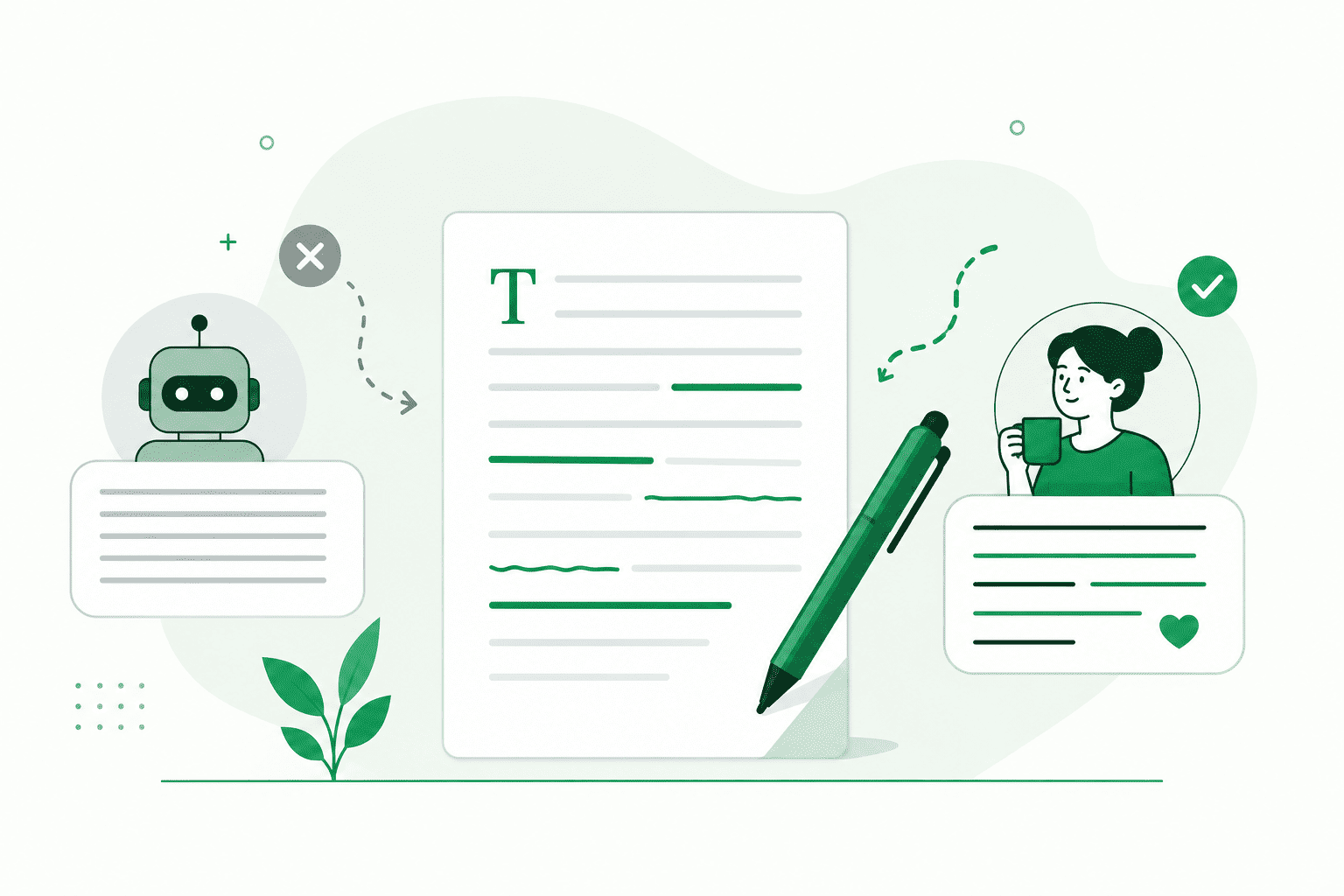
It's 11pm and you're staring at a blog draft that's technically perfect and somehow completely dead. Every sentence is grammatically sound. The structure makes sense. The advice is even correct. And yet you read it back and think: nobody talks like this. Nobody thinks like this. If a friend sent you this paragraph, you'd wonder if they were feeling okay.
That's the moment most people discover the gap between "well written" and "human sounding." They're not the same thing, and confusing them is exactly why so much AI-assisted content reads like a instruction manual with better vocabulary.
Here's the good news: sounding human isn't a personality trait you either have or don't. It's a set of specific, learnable moves. Once you know what they are, you can build them into your writing process on purpose, whether you're drafting from scratch or cleaning up an AI-generated first pass.
Why AI Drafts Read Flat by Default
Large language models generate the statistically likely next word. Left alone, that pulls every sentence toward the average: average length, average rhythm, average phrasing. Nothing is wrong exactly, but nothing sticks either. It's the writing equivalent of beige.
There are four things missing when a draft reads this way.
Burstiness. Human writing varies wildly in sentence length. A short one. Then something longer that winds through a thought, doubles back, adds a clause, and lands somewhere unexpected. AI text, without guidance, is metronomic. Every sentence is roughly the same size, and your brain notices the pattern even if it can't name it.
Specificity. "Many writers struggle with consistency" tells the reader nothing. "I missed my Tuesday post three weeks running because I kept rewriting the intro at midnight" tells them everything. Specific details are what make a reader nod and think, yes, that's exactly what happens to me.
Vulnerability. Real writers admit what didn't work. They hedge. They say "I thought this would be simple and it wasn't." That kind of honesty is almost never present in generic AI output, which tends to state everything with the same flat confidence, whether it's a fact or a guess.
Direct address. Real writing talks to somebody. It uses "you," asks the occasional question, and drops in the odd "here's the thing." Take that away and the text starts talking about the reader instead of to them, which is a small shift that changes everything about how it lands.
Start With the Reader, Not the Topic
Most drafts fail before a single sentence gets written, because the writer starts with the topic instead of the person reading it. "Write about productivity tips for remote workers" gives you nothing to work with. Compare it to this:
The reader is a remote worker who has tried four different productivity systems and abandoned all of them by week two. They're not lazy, they're just tired of advice that assumes they have an office door to close and a partner who understands "in a meeting" means don't interrupt. They'll know a piece of writing actually gets them when it mentions the specific chaos of a kitchen table doubling as a desk.
Notice how much easier it is to write toward that person than toward "remote workers" as a category. Before you write a single line, try finishing these:
The reader is struggling with ______ because ______.
They've already tried ______, and it didn't work because ______.
They'll know this piece actually helped when they can ______.
Build the Piece Around a Real Moment
Generic openings kill more blog posts than bad grammar ever will. "In today's fast-paced digital landscape" is the writing equivalent of clearing your throat for three paragraphs. Readers skip it, and so should you.
Open with something specific instead. A moment. A failure. A time you got it wrong. Drop the reader into a scene they can picture, then let the advice grow out of that scene instead of arriving as a disconnected list. If you're writing about time management, don't open with a definition of time management. Open with the Sunday night you rewrote your whole week's schedule because Monday's plan fell apart by 9am.
From there, structure the piece so it breathes:
A real scene that shows the problem.
A short beat explaining why the issue is trickier than it looks.
Three or four concrete strategies, each with an example attached, and at least one honest "this one didn't work for me" moment.
A close that ties back to the opening scene instead of a tidy, generic wrap-up.
Say It Like a Person Would Say It
Vague voice instructions produce vague writing. Telling yourself, or an AI tool, to write "professionally but friendly" tends to land on the same bland corporate tone everyone else is already using. Get specific instead:
Write like you're explaining this to a colleague over coffee, someone who's been in the trenches and isn't afraid to admit a mistake. Use contractions. Let sentences run long when a thought needs room, then cut back to something short. A little imperfection is the point, not the flaw.
Read every paragraph out loud before you publish it. This one habit catches more robotic writing than any editing checklist ever will. If your voice flattens by the second sentence, or you stumble over a phrase that looked fine on the page, that's the tell. Rewrite it until it sounds like something you'd actually say to someone's face.
Watch for the Words That Give It Away
Certain phrases are almost a signature of unedited AI text: "delve into," "in today's landscape," "moreover," "it's worth noting," "in conclusion," "unlock," "revolutionize." None of these are wrong on their own. The problem is how often they show up together, in the same predictable spots, in piece after piece.
Keep a running list of words you've banned from your own writing and check drafts against it before you hit publish. It takes thirty seconds and it catches a surprising amount.
The Real Fix Isn't a Better Prompt or a Better Filter
Here's the part people don't want to hear: no single tool fixes flat writing on its own, and that includes AI detectors, humanizer tools, and clever prompt tricks. They all help. None of them replace the actual work of thinking about a specific reader and telling them something specific and true.
The most reliable process still looks like this: you set the direction, the tone, and the real detail that only you know. AI can help generate a draft or smooth out rough phrasing at scale. Then you go back through it as a human, adding the detail nobody else could have written, checking that it still sounds like you from the first line to the last.
That's really the whole idea behind a tool like this one. It's not about tricking a detector. It's about closing the gap between writing that's technically fine and writing that actually sounds like a person wrote it, because in the end, that's the only kind of writing anyone wants to finish reading.
 GPTZero
 Turnitin
 Originality.ai
 Copyleaks